About seven years ago, I met one of my closest friends at a coffee shop. I had arrived with my younger brother, and the two of us were sparring playfully—throwing light insults back and forth about some family disagreement we had turned into a joke.
When my friend arrived, she sat down quietly and observed us. My brother eventually gathered his things and left. A few moments later, she looked at me and said she was disappointed in the way we expressed affection: through insults disguised as sarcasm.
She wasn’t angry. She wasn’t harsh. Her tone was calm.
But I felt my cheeks flush with embarrassment. It wasn’t her volume that lingered, it was the weight of her words.
I never forgot that moment.
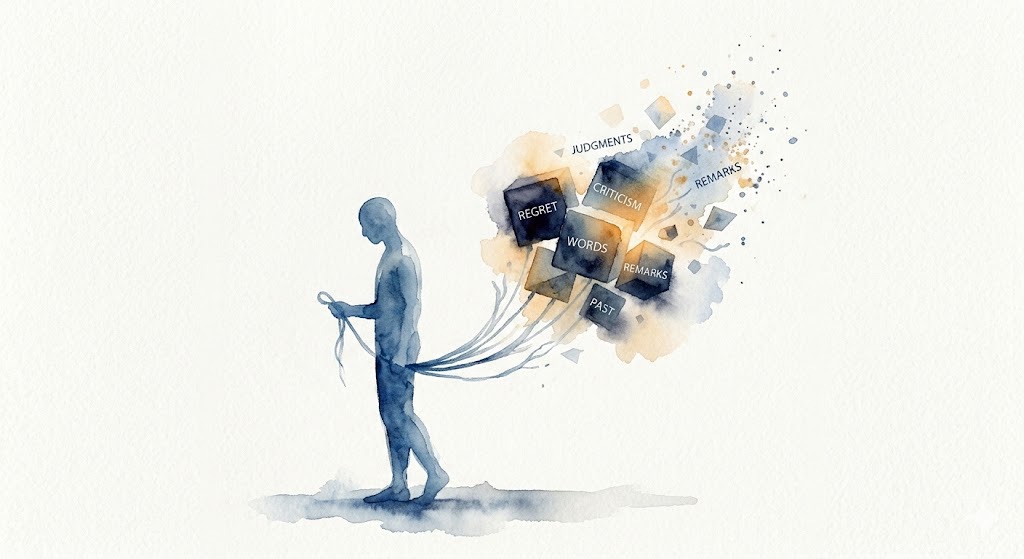
And what struck me later was something strange about human psychology: we often carry criticism as if it’s permanent, while the person who said it has long since moved on.
The Spotlight Effect
As humans, we tend to overestimate how much other people notice and remember our behavior. Psychologists call this the spotlight effect.
My friend knew the unhealthy dynamics I had grown up with. I had confided in her about how unheard I felt in my family, how quickly judgment replaced understanding. So when she pointed out that I was engaging in the very behavior I criticized, it felt devastating.
To be deeply understood is comforting.
But to be deeply observed can feel terrifying.
In that moment, I felt exposed, like a contradiction had been illuminated. I replayed her comment over and over in my mind. Meanwhile, she likely went on with her life, unaware of how long I carried it.
Think about the last time someone made a casual remark to you. Maybe it was small. Maybe it was said in passing. And yet weeks, months—sometimes even years later—it resurfaces.
Regardless of the speaker’s intent, well-meaning, careless, or critical, your brain replays it until it feels permanent.
Emotional Memory Amplifies Minor Moments
The brain prioritizes emotionally charged experiences. It files them differently.
When I was a young girl, I once sat on my mother’s bed talking and laughing with her. In the middle of our conversation, she paused, looked at my face, and said, “Your nose is crooked.”
I had never noticed.
Later that day, I locked myself in the bathroom and stared into the mirror. I studied my face with new suspicion. Had I been walking around unaware of some visible flaw? The thought consumed me.
To her, it may have been an observation.
To me, it became a narrative.
A mild comment became monumental and not because of its objective weight, but because of my developmental stage and emotional vulnerability. A young girl will internalize comments about her body far more intensely than an adult might.
My mother likely forgot she ever said it.
I didn’t.
That’s how emotional memory works. The brain encodes shame, fear, and embarrassment more deeply than neutral experiences. It’s a survival mechanism but in modern life, it often misfires.
Perceived Judgment Isn’t Always Actual Judgment
Often, what we interpret as judgment is care, concern, or an attempt at guidance.
That doesn’t excuse harmful remarks. My mother’s comment about my nose wasn’t necessary. My friend’s observation stung deeply. Impact matters.
But impact and intention are not always aligned.
Another person might have responded differently than I did. They might have challenged their friend. They might have confronted their parent. They might have dismissed the comment entirely.
And that’s valid.
My purpose in writing this isn’t to minimize the power of words. It’s to examine why they linger so long in our minds.
When criticism resurfaces, it’s worth asking:
Is this memory heavy because of what was said or because of the meaning I attached to it?
Interpretation gives memory weight.
Repetition makes it feel permanent.
Understanding this doesn’t erase the sting. But it does return power to us.
We may not control what others say.
But we can learn to loosen the grip their words have on our identity.
And perhaps that is where wisdom begins: not in avoiding criticism, but in understanding the mind that holds onto it.
 N.T. Romero